Updated: December 2, 2025 (December 2, 2025)

  Blog

CIO Talk: Microsoft Gets IQ

My Atlas / Blog

1,371 wordsTime to read: 7 min
Barry Briggs by
Barry Briggs

Before joining Directions on Microsoft in 2020, Barry worked at Microsoft for 12 years in a variety of roles, including... more

By Barry Briggs

Let the semantic-layer wars begin!

A little over a month ago, I made the less-than-prescient claim that “Microsoft has done little to nothing about a semantic layer.” But – in fairness to me – I also mentioned “rumors of a stealth mega-project underway at Microsoft to build some sort of ‘semantic layer’” that might compete with leaders in the field like Palantir, Celonis, AtScale, and others.

At Ignite two weeks ago, a succession of speakers elaborated upon a new brand, called “IQ,” that purportedly brings new intelligent capabilities to Fabric, Microsoft 365, and Azure AI Search, called, respectively, Fabric IQ, Work IQ, and Foundry IQ. (These appear to supersede an earlier capability called Context IQ, introduced in 2021.)

Let’s unpack these important announcements. First, we’ll discuss what they are and what they can do for you; then we’ll compare and contrast them with other offerings in the industry, notably Palantir, and what it means for them; and lastly, what’s likely to come next.

The Three IQs

As I mentioned, at Ignite Microsoft announced three new features under the IQ brand; each of these layer on top of existing products with the goal of further empowering both end users and the AI agents that Microsoft expects will become prevalent. Each, in different ways, builds a “knowledge graph” of the underlying data store – that is, links and relationships between disconnected pieces of data. Such a graph might, for example, connect a database of employees with a facilities database, enabling insights for how well office space is used, if teams are collocated, and so on.

In each of the three new capabilities Microsoft builds on existing layers.

Work IQ unsurprisingly leverages Microsoft 365’s Graph API – which already maintains many such relationships – and adds so-called “memory” features, learning and recalling users’ actions and habits. Thus a user might ask Microsoft 365 Copilot to “find the email from Susan a few weeks ago, put in the pricing she suggests into a contract like the one we did with Acme, customize the logos appropriately, and generate a Word document,” or “create a detailed financial model of the proposed acquisition of Contoso” in Excel.

In Fabric IQ, Microsoft again leverages an existing capability, in this case the semantic models created in support of Power BI applications, to create a knowledge graph of the department or enterprise. Alternatively, data professionals can create their own ontologies (maps or blueprints of the relationships between key subject areas); for example, product > part > supplier > contract > terms, using a new Fabric ontology tool (in preview).

Microsoft claims that Fabric IQ helps resolve core business concepts (“customer,” etc.) and illuminates relationships to other entities. (As we’ll see, this is harder than it sounds.)

Moreover, with two new agent types, Data Agents and Operations Agents (the former being in preview all year), enterprises can deploy sophisticated chatbots and even operational (IoT) agents that monitor devices in real time and predict and prevent failures, respectively. (Note that both of these agents are designed to work without Fabric IQ but have more capabilities with Fabric IQ.)

Finally, Foundry IQ, based on Azure AI Search (and built by that team), helps developers quickly index enterprise data sources and make them available to whatever agent might need them. Instead of a RAG application querying a single data source, Foundry IQ simplifies the ability for such apps to examine a range of sources.

The New New Application Stack

Back in April, I posited that Microsoft’s vision for the AI-centric application stack consisted of a UI layer (Copilot); logic (AI agents); data (Fabric, et.al.); and hardware (massive data centers).

We need to tweak the stack a bit: Microsoft has added a new “semantic layer” to its data sources, with the goal of enabling agents (and humans) to make increasingly better decisions. (I say “increasingly” because over time agents – in theory – learn and fine-tune their actions.)

What Could Possibly Go Wrong?

It’s a compelling vision, but it’s likely that the pesky realities of enterprise data will slow adoption. Few enterprises have a well-architected enterprise data model (EDM), as we discussed in our previous blog post. So – for example – what happens when the carefully designed definition for “customer” created in the ontology tool conflicts (say, in something as trivial as the number of address lines) with that in one or another system? Or when a salesperson insists on one definition and the finance analyst, another?

Creating an ontology, in Fabric or elsewhere, is a major effort and requires on-going maintenance, so there’s no getting out of the hard work. For example, the Fabric ontology tool can discover Azure hosted data and build the foundation of an ontology on what it sees, but bringing in external data sources like an Oracle cloud database takes manual effort.

Even with auto-discovery, the people you charge with building and maintaining the ontology will face a hill of challenges, determining how one data source relates to another, what column names to use, how to resolve ownership of data that appears in two sources, creating additional dimensions (data from data) to address a business demand, and configuring triggers that allow data in one source to act on data in another source. And what happens when one of the external data sources inevitably changes? And, they have to do all this while following the security requirements and data sovereignty of each data source.

Still, the appearance of semantic-layer technologies across Microsoft’s portfolio can enable some powerful usage scenarios – yet another reason, perhaps, for enterprises to embark on data hygiene projects. (I recommend, based on experience, to start at the department level before taking on something as massive as a full EDM: quick wins to show value and focusing on where the data is created can accelerate adoption and convince skeptics.)

The Semantic Wars: Who Do You Back?

Since the announcement of the “IQs,” lots of virtual ink has been spilled comparing them to established vendors, most notably Palantir. Here’s a quick summary of the situation as it stands today:

  • Work IQ, Fabric IQ, and Foundry IQ are new (with many of the features still in preview) and not yet widely adopted; however, for Microsoft-centric enterprises they’re likely the right choice, since they build upon and leverage existing features in the underlying platforms and services.
  • The IQs are three disconnected services which – frankly – highlight Microsoft’s organization chart and will add complexity to creating agents that must span all enterprise data.
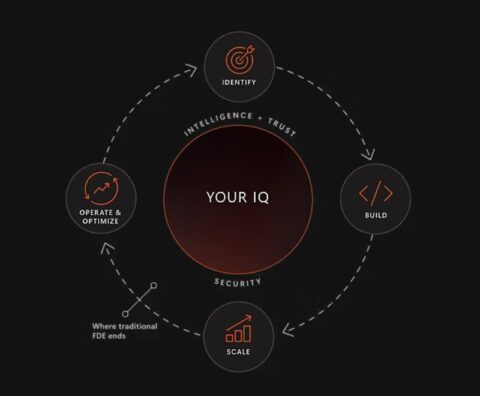
  • Palantir’s Foundry (yes, the same name) is more mature and widely adopted, particularly in operational IoT scenarios. Its strategic focus is to help enterprises build a “digital twin” of their operations.
  • Palantir’s metamodel consisting of entities and relationships (semantic layer); actions and functions (kinetic layer); and security and permissions (dynamic layer) is well thought out and cohesive. But Palantir relies on a hands-on consulting engagement with their own “forward-deployed engineers” or Accenture, Deloitte, and/or others to create the specific instances of the metamodel, which can be expensive and time-consuming.

What’s Next?

There’s undoubtedly more to come in the world of IQ. I’d hardly be surprised to learn of a “Purview IQ” which could leverage Purview’s Unified Data Catalog to reach into non-Microsoft data like Snowflake or Databricks, or even data in other clouds.

Similarly, I’d also expect IQs on each of the Dynamics 365 applications – Finance, Supply Chain Management, HR, and so on, with a Copilot UI on each of them. (Let’s just hope the “IQ” brand doesn’t get quite a dilute as “Copilot.”)

Are Systems of Intelligence Here?

Whew!

My personal opinion is that of all the announcements at Ignite, the IQs will become the most important and consequential. Perhaps indeed we are at the dawn of what Geoffrey Moore and George Gilbert called (all the way back in 2015) “systems of intelligence” that can “[mine] engagements in real-time to anticipate, influence, and optimize customer experiences.  In their most advanced form, these systems learn both from the user’s interactions as well as external observations such as an extended network of relationships.”

Do I need an IQ layer? Drop me a line at bbriggs@directionsonmicrosoft.com.

Before joining Directions on Microsoft in 2020, Barry worked at Microsoft for 12 years in a variety of roles, including as Chief Technology Officer for Microsoft’s own IT organization for... more