June 24, 2026
BlogUnderstanding M365 E7: The Three Risks Behind the $99 Price PointÂ
On May 1, Microsoft introduced Microsoft 365 E7 at $99 per user per month. From the start, there was reason to suspect that number was an opening position, not the whole picture.
Two months in, the evidence is mounting fast. Three distinct cost risks compound around the $99 seat. All three are now in motion. And the $99 number, on its own, is only the down payment on the total investment required to operate E7 at scale.

Most E7 conversations begin at $99 for some portion of your knowledge workers. But few will stay there. Coverage will expand beyond that initial population, because agentic AI isn’t built to tolerate partial deployment. Azure meters will stack on top of the seat, spinning according to arcane rules no one fully grasps until the bill arrives. And the licensing models underneath will shift without warning, as chaotic as the AI industry itself right now. Three risks. One cost picture. None of it visible from the seat price alone.
Risk No. 1 – Coverage Expansion: AI Will Reshape Your Licensing Footprint
The first risk to the $99 price point is the simplest. The number of users at that price point is going to grow. Most E7 conversations start with a question about which knowledge workers need it. The honest answer is that the question itself is becoming obsolete.
AI is expanding across the knowledge workforce faster than any productivity technology in recent memory. The marketing analyst with no engineering background is now building automations that used to require IT. The lawyer is drafting research workflows that used to require a paralegal team. The salesperson is generating account briefs that used to require a research subscription. Once one role on a team has agentic AI, the rest catch up quickly, because having access to AI is a material advantage at work.
Plan for coverage to extend to your full knowledge worker population within the commitment period. That expansion is only the beginning. The agentic phase doesn’t stop at the knowledge worker boundary. It crosses into the frontline workforce in two distinct ways.
The first is the AI-ambient frontline worker. This is a worker who doesn’t directly use Copilot but whose work environment is touched by agents. An HR agent handling benefits questions. A helpdesk agent interfacing with ticketing systems. An internal chatbot at a service counter. These frontline workers don’t need a Copilot seat. They do need the governance stack underneath one. Defender and Purview classify and protect the tenant data the agents pull during those interactions. Agent 365 and Entra ID Governance ensure those agents can only act within the worker’s authorized scope.
The second is the AI-enabled frontline worker. Think of the field service technician dispatched to a critical equipment failure. She arrives onsite, opens her phone, and walks the AI through what she’s seeing. The AI pulls the maintenance history for that specific machine, surfaces the three most likely failure modes given the symptoms, retrieves the relevant parts diagrams, and drafts the customer-facing service report as she works. She is not a knowledge worker. She is not at a desk. But she is in active conversation with AI throughout her shift, and the work she does looks fundamentally different from what it looked like a year ago.
No F7 Yet. But What It Might Cost to Build One

This group of AI-enabled frontline workers s the population that needs the full F7-equivalent stack. This means the governance components above, plus M365 Copilot at $30, because no Frontline version of Copilot exists. The technician using AI as a partner needs the same Copilot license a software architect or a financial analyst would need, even though her role looks nothing like theirs. Microsoft hasn’t created an F7 tier, so properly licensing these populations requires assembling the components yourself.
Risk No. 2 – Consumption Stacking: The Add-Ons Are Back, Again
We saw the add-on risk coming when E7 was first announced, and after months of Microsoft hinting at it, it has become a reality. Exhibit A is Work IQ. Exhibit B is Cowork.
Work IQ is the clearest example. Microsoft held Work IQ in preview for over a year as the intelligence layer powering Copilot’s understanding of your organization. Free during preview. Foundational to every agent built on the platform. On June 16, 2026, Microsoft activated consumption billing for the Work IQ APIs. Same product, same value, suddenly metered for anyone building their own agents or apps calling the Work IQ APIs, or invoking a third-party agent that uses Microsoft 365 data through the Work IQ APIs.
Cowork followed the same pattern, going GA with its own separate meter. Copilot Studio Credits meter agent actions on top of Cowork and the Work IQ APIs. None of these meters is included in E7, but they are required to do the work that E7 is sold to enable.
It took Microsoft years to add the first significant billable add-ons to M365 E5. E7 hasn’t even made it two months. The seat price to which you commit opens the door. The capabilities behind that door are likely to land as additional consumption bills, and the catalog of those kinds of add-ons will only grow.
Risk No. 3 – Commercial Shifts: Sudden Changes That Scramble Your Assumptions
The first two risks outlined above describe future changes that follow patterns you can forecast. The third describes changes you can’t.
Within a single 14-day window earlier this year, Microsoft posted the Work IQ general availability notice, activated consumption billing on the APIs for the same product, made Cowork generally available with its own meter, and updated the Agent 365 product terms to add a frontline worker prerequisite path. That window was not a one-off. It’s characteristic of the commercial environment around enterprise AI in 2026, where vendors are restructuring pricing models in public at the same time that customers are signing multi-year commitments against them.
The pattern is bigger than just Microsoft. In April 2026, Anthropic restructured its Claude Enterprise pricing, replacing large fixed subscription tiers with a lower headline seat fee combined with mandatory consumption commitments. Token unit prices didn’t change. The risk did. Enterprises that had signed deals expecting a stable rate scrambled to model the new cost geometry mid-term.
Your Enterprise Agreement term protects your seat price. Everything that lands on top of that seat during the term is determined by decisions Microsoft and its peers will make later, in an environment where the pace of those decisions is accelerating.
Elevate Risk in Your E7 Negotiation Strategy
In stable times, cost is the metric. You negotiate hard against price, and the deal structures you accept in exchange for those discounts apply cleanly against a future where change is measured and predictable. That’s been the model for enterprise Microsoft agreements for two decades.
AI breaks the model. The shift from perpetual to SaaS was a change in how software was delivered. AI raises the possibility that the software layer as we’ve known it may be giving way to something else entirely. Agents that compose their own workflows. Models that interpret intent rather than execute instructions. The SKU on your renewal sheet may describe a product that’s evolving faster than the contract terms can keep up with.
That kind of underlying instability changes the calculation. Scrutinize any E7 offer in front of you with these three risks in mind. Every term that trades flexibility for discount deserves a sharp look.
Paying $99 per month for just some of your knowledge workers is the first chapter. What that story grows into over the life of the commitment, as coverage expands and consumption stacks and commercial terms shift, is where the full cost of E7 lives. You need to negotiate the whole story.
Understanding M365 E7 Series
Part 1: Why E7 Is More Than Just a New Licensing Tier
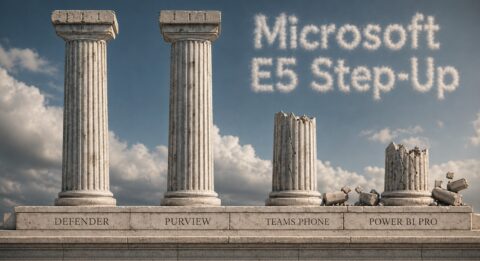
Part 2: Beware the Step-Up Offer
Part 3: The Three Risks Behind the $99 Price Point (this article)